Saturday, 20 January 2018

Orissa--a road trip


Chilka Lake

"Traveling makes you wise and humble."


Our road trip in Orissa began in Bhubaneshwar. We hired a Zoom-car, attached the GPS to the squeezy and took off for Pipli. A small dusty town made famous by its art and craft, a delight for the shopaholics who would like to pick up sun-umbrellas, canopies, totes, shopping bags etc. The streets are lined with stalls selling appliqué work making  the town colourfully delightful.
 The people of Oriya are simple, traditional, and fiercely religious. There is a temple at every bend. Bhubaneshwar is, not surprisingly, called the “the temple city.”  Religiosity consumes a lot of time, energy and money of the ordinary Oriya. Spiritually vibrant Jagganath in Puri is the most revered temple and is visited by 4million people every year, despite the  the lack of a peaceful and religious ambience. Pestering for money and brusque behaviour by the priests are familiar stories narrated by visitors leaving many to wonder why they ever visited the place. However things are changing and efforts are being made to bring about an orderliness. Non-Hindus are not allowed into the sanctum sanctorum.

Applique work at Pipli

We drove to Dhauli from Pipli, the place where Emperor Ashoka gave up warfare after the Battle of Kalinga and embraced Buddhism. Three of his edicts are preserved in a glass-case and a new Asoka pillar has been constructed to commemorate the event. The park and the edict are well maintained by the Archaeological Survey of India. The Shanti Stupa on top of the hill is worth a visit. The adjoining Shiva temple is a little disorganized and can be avoided.
We wove our way to the town of Konark, home of the “Black Pagoda”. The epithet was tagged because the temple appeared black to the sailors out at sea. It was believed a 52 tonne magnet in the temple attracted the ships towards it and  maintained a balance of the 5 temples in the precincts. The temple was plundered and the magnet robbed by the Portuguese. Consequently, the smaller temples crumbled leaving just one damaged temple standing precariously supported by scaffoldings. Representing a chariot of the sun-god driven on 24 wheels it was built by 1200 workers and took 12 years. It was never a practising temple, no offering was ever made and no “mantra” recited. Today it is beautifully maintained by the Archaeological Survey of India. There is a foot-path all around the edifice providing a 360 degree view. Restoration work has been going on for the last 15 . It would be wise to take a guide for Rs.150-200.The temple’s architecture and grandeur will unfold when explained by a guide. Stalls line the entrance where you can pick up trinkets and flop- hats for a steal. There are no star  hotels in Konark. It is best to commute from Puri or Bhubaneshwar. We stayed in “Surya Inn” which was not good enough . However it was conveniently located 400 metres from the temple and served our purpose. The Konark museum is worth a visit.  


Sun Temple, Konark


Next morning we drove to Chilka Lake via Puri. Chilka is a lagoon covering 1100sq kms, a huge expanse supposedly the largest brackish water lake in Asia.  Home to over 220 species of local and migratory birds, dolphins and variety of fish providing a life-line to all the fishing villages .We did get to see a lot of birds but few dolphins. A motor boat ride around the lake and islands is serene, interesting and informative. Be wary of guys who try to sell corals and pearls whose value is questionable.
pearls from oysters
The boys will break the oyster-shells and take out a pearl or two but don't be deceived ....they may not be genuine. On the down-side the touts for the boats can make your life miserable. You have to be politely firm with them.


Motor bikers can make you lose your peace of mind therefore drive cautiously. In Puri cows do the work of road dividers. Gushing pilgrims are unmindful of cars cruising around. Traffic policemen are not visible to regulate the flow. Driving is a herculean task. Life goes on without complaint and people appear not to be too unhappy.

We returned to Bhubaneswar on the third day to cover the tribal museum, Udaygiri caves, Lingaraj temple and KIT University which supports 22000 tribal children with free accommodation, food and education. An initiative by Achuyta Samanta it is a noble movement and has gone a long way to uplift the tribal society and curb insurgency. 22% of Orissa’s population belong to different tribes who are poor and down-trodden. The Bonda (the naked tribe) are a dwindling race leaving just about 12000 of them. Tribal art is very attractive. Silver filigree work, patachitra paintings, katki designed fabric and saris can be bought from the innumerable shops in and around the state capital.
Oriya cuisine is subtle in taste and low in calories. Among the sweets Rasabali and steamed chenna poda will take the first prize. Both are delicious. Many dishes are made with mustard be it vegetables or fish. Chakuli pitha is a breakfast dish resembling pancakes made with rice flour. Saaga Moonga (leafy vegetables cooked with lentils are popular. Tangy chutneys are also popular and there are many variations like tomato, oou (elephant apple) raw mango. But an Oriya meal is never complete without dalma, a dish made out of vegetables and lentils. It is offered to the Gods too.
The trip was an eye-opener to the state of Orissa. We just scratched the surface. Much more is yet to be discovered.

Chenapoda....steamed milk cake


Friday, 5 January 2018

Kolkata--City of Joy

Howrah Station

                              " Kolkata is always dying but it never dies"


 Kolkata is a city where human values are not measured by material wealth but by the warmth, hospitality, cultural and intellectual abilities extended by ”bhadraloks” (gentlemen} It is chaotic, crowded, colourful,crazy and yet there is an orderliness in this madness. If you come once you will promise you’ll never come back again but once you are back home you will yearn to return to the city which stands by the river Hooghly, where the average nominal per capita income is $2000 per year, where you can have lunch for $1 and splash $200 dollars for dinner at a flashy 5 star hotel 


Most things don’t change in Kolkata. Therefore, the obsolete, loss-making trams still run on tracks   built by the British. Its ride through history but you can’t depend on them to reach an appointment, slow and sluggish that they are. The man-drawn rickshaws have stood the test of time no matter how cruel it looks.  Thousands would be thrown into the den of unemployment if they were to be withdrawn. The omnipresent yellow Ambassador-taxis are indispensable .Hindustan Motors factory but the Ambassador lives on in the metropolis. They are always at your beck and call through hail or storm, though some drivers may refuse to turn the metre on or may ask you for Rs10 extra.  “Nahoums” bakery in New Market is still selling its delicious fruit cakes from the same wooded cases that the Jewish owners had set up decades ago. Nobody wants anything to change. That’s the attraction of the place.

                                                     
Kolkata Tram
The British when they reached Kolkata brought not only the Queen’s language but also their baroque and neo-classical architecture, grand and over-powering. The National Library, Writer’s building ,the Grand Hotel, the Museum   remain very British in appearance  It is worth doing a architecture tour of the city which perhaps will take you more than a day.

 The iconic Victoria Memorial which stands imposingly in the centre of the city serves as a tourist attraction, a jogger’s park and picnic spot. However don’t go to any of the touristy places on holidays. It’s a melee.

                                             
Victoria Memorial

Each attraction in Kolkata is wrapped in a story. The old Howrah bridge and the new Vidyasagar Setu represents two eras, two Indias both different yet compatible.  I like the Howrah railway station with its 23 platforms and the big clock( it's not working now) which was built in 1926 by Gent’s of London serving as a prominent meeting point for many.
The Bengali cuisine excites the palate like no other. River or sea fish is an integral part of the menu. The “Rasgolla “and sweet curd is the finale to a hearty meal. Some note-worthy restaurants are Oh Kolkata (10/3Elgin Road) Kasturi (Ballygunge) and Bhojohori Manna (Gariahat)
 Upmarket Park Street hosts a number of good restaurants and a few offer music in the evenings. Go to “Flury’s “for an English breakfast or afternoon tea, “Cha Bar “at Oxford Book Store for a mid-morning cuppa to taste the original Darjeeling or Assam tea while browsing through a book. Dinner could be at “Mocambo “Bar-B-Q” or “Peter Cat”.  Originally the street was through a deer park, hence its name. Officially, it is known as Mother Theresa Sarani.
Plate of Rasgullas
 Kolkata clubs are little islands of British culture. Every member holds very dearly to the customs, mores and etiquette and is more British than the British themselves. The Tollygunge club is the only country club in India more than 220 years old. The Bengal club is famous for its Christmas lunch. Should you get an invite to any of them, don’t miss out. 

Kolkata has provided a home for one and all. Parses, Greeks, Armenians, Jews, Chinese and the English have made it their home over the years, each community contributing to its growth. Around 2000 Chinese have their own China Town where Chinese festivals are celebrated. Mother Theresa made it her own and brought joy to many. A visit to her home will complete your trip.  We decided to make it by foot. With GPS data connection poor and human GPS most unreliable (we asked two policemen, three gentlemen, and two shop-keepers for directions) we walked a maze of streets covering 4.9 kms to reach the home ....serene and peaceful.....an island of bliss in this noisy city....it was worth it !!!!But what surprised me was that 7 people didn’t know where it was located....People’s memories are very short unfortunately. Besides the walk was not easy .The sidewalks have been converted to showrooms for tyers and garments leaving us to the mercy of cars that zoomed by.

My love-hate relationship with the city has brought me back an umpteenth number of times and every time I have something new to write home about. 

At Mother's Home

Friday, 7 July 2017

Cherrapunjee.....the rainiest spot on planet Earth

" Do not be angry with the rain; it simply does not know how to fall upwards." V. Nobokov


 With an average annual rainfall of 449.6 inches (yes, you have read it correct) it is the wettest spot on Earth. The drive from Shillong to Cherrapunjee ( also known as Sohra) is breath-takingly beautiful with the fog embracing you and droplets of water drawing out patterns. Dont forget an umbrella which goes without saying . Or better still a raincoat because your umbrella may be swiped away by the strong wind. Yet, during the dry season there is a shortage of water which brings up pertinent questions of water-harvesting. The area is inhabited by the Khasi tribe and they are  a matrilineal society.  If you are an adventurous foodie try Khasi food . Jadoh(mixture of rice and pork)Ja Stem(rice cooked with turmeric powder and sesame)Tungrymbai (fermented soya beans and spices)For this dish dont go by the smell but the taste!Dohneiiong (smoked pork with black sesame seeds) is delicious and comes very close to BBQ pork.
There are many places one could stay but I would weave my way to Jiva Resort for a holistic experience.


Jiva resort

Nature is at its best in this region. Unspoilt and prestine. It's enough to watch the rain come down or listen to the pitter-patter on the tin roofs. Most houses have slanting roofs for the water to drain off. Waterfalls ,big and small, are well fed by the monsoon rains and the springs that abound. Its a lovely place in the amazing state of Meghalaya, North-east India......remote and beautiful!!!


waterfalls


Thursday, 8 June 2017

Chocolate Ring Cake with ice-cream and watermelon


"All the world's a birthday cake, so take a piece but not too much." George Harrison.


My grand-daughter, Molly, loves to play Housie –house in her fairly large toy kitchen. She cooks up muffins, sunny –side up eggs, steak and her favourite peanut butter sandwiches with lettuce.  To be a part of her world, I bought a cake mould in the shape of a ring and involved her in the entire process. What fun we both had! The child in me got the upper hand and we became messy together. She picked up culinary terms which would baffle many of her friends I’m sure. But the end product was a delight!!  

So here we go:

Ingredients

100 grams sugar                                                      to decorate: 

100 grams flour                                                       1 brick Ice-cream

100 grams butter                                                      1 cup watermelon balls

4 eggs                                                                       1/3 cup cooking chocolate

30 grams cocoa powder                                           ½ cup cream

1 level tsp. baking powder

Pinch of soda-bicarbonate

Pinch of salt

A few drops of Vanilla essence

Method

1.Grease an 8”ring- cake tin. Sieve the flour, cocoa powder, salt, baking powder and soda bi-carbonate together twice.

2.Beat the sugar and butter. Add the egg yolks and beat into the butter mixture.  Keep it aside.

3.Beat the egg whites till fluffy.  Fold the egg whites into the sugar-butter mixture till smooth.

4.Fold in the flour with the rest of the ingredients raising the ladle high to let in air.

5.Stir in the vanilla essence.

6.Pour into the greased tin and bake for 30 minutes in a pre-heated oven of 180 degrees.

7.Remove and let it cool.

Decorations:

1.Melt the chocolate in a double boiler. Add cream. Stir till smooth and shiny. (Chocolate ganache) 

2.Pour over cake evenly.

3.Fill the centre of the ring with ice-cream and melon balls.Sprinkle coloured sugar balls all around       to give the final touch.

4. Serves 6 to 8 people.


Note: I love traveling but I enjoy making desserts too.


Wednesday, 7 June 2017

Russia : land of the onion -domed churches


     "The world is a book and those who do not travel read only one page." St. Augustine


Russia has a distinct character, very original and varied. You have to see it to believe. It is neither European nor Asian. It is Russian. European Russia makes it the biggest country in Europe and the Asian part makes it the largest in Asia. The nation is mysteriously enormous, covering almost 11%of the land mass with 11 time zones, 25 official languages and more than 110 unofficial ones.
We decided to fly into Sheremetyevo last March with apprehensions of what to expect of a country which Churchill described as a “riddle wrapped in a mystery inside an enigma”. We were taken in for a surprise at what we found –the people, the terrain and cuisine were fascinating .We flew Aeroflot where the crew was polite, professional and pretty. It’s a great airline for the price you pay.

March is a good month to visit Moscow. Not very cold, no rains either and fewer ant-like tourist groups. Consequently queues are shorter at the visitor’s counters, buses are less crowded but metros are not. You might miss out on the street food because the food stalls were few and far between. Trees are bare but beautiful and flowers are just about coming out of their hibernation.   


Bare and beautiful

The gentleman from Angel Taxi Agency was on the spot at the dot of time as we came out of the airport foyer. Most amiable, we handed him the address of our hotel neatly written in Russia and he very politely ushered us into the car. It was a strange situation where he understood English but couldn’t speak and we could read the Russian script, Cyrillic, but couldn’t speak except for a smattering of phrases with a strange accent which no Russian could understand. The day was cloudy and a little dreary but, Yuri,   our chauffer, made it the most delightful trip by pointing out landmarks and cracking jokes which he only understood but we laughed along. The grandeur of the baroque buildings left by the Tsarist regimes stood side by side with the Soviet-era blocks, interspersed by malls and a few high-rise buildings. Traffic, like every capital in the world was nothing to write about and you do notice a few jumping lines and taking a turn when you shouldn’t. If you want to see sky-scrappers and all the modern trappings that go with them, go to New Moscow.


Kremlin
Yuri drove us into Nastasyinsky Perulok Street in Tverskoy to our hotel Pushkin. The proximity of the hotel to three metro stations, Trevaskaya, Chekovskaya and Pushkinskaya made it very convenient to for us to reach all corners of Moscow. The Red square and the Kremlin were within walking distance. We were well received by two pretty girls who spoke English and didn’t waste time with inane niceties. Our room was small but convenient, clean and modern. Hot water and ice was available just across the room. The dining space was artistically done up, keeping the writer Pushkin, in mind. The complimentary breakfast was well laid out. The minus point of the hotel was the shower –cubicle which was tiny and would well make it difficult for a fat man to manoeuvre. But would I stay here again? Definitely.

Chicken Kiev at Hotel Pushkin

Armed with a few Russian phrases like”Da”,”Nyet” “Spa-see-ba” we began our march into the land of Lenin, Stalin and Putin . Russians have been storied and parodied as unsmiling, stern-lipped vodka-drinkers but they turned out to be friendly and helpful. Nothing appeared intimidating; there was no cold-sweat seeing the Lubyanka building, HQ of the erstwhile KGB now known as FSB. There are more channels on TV than the propaganda channel. You are not under surveillance as we were made to believe. The only time I did feel uneasy was when burly Russians were trying to sell us tickets outside the Bolshoi Theatre Moscow, at an astronomical price. With a burgeoning middle-class with growing purchasing and a new generation of ambitious youngsters who are keen to learn, Russia has come out of the Cold.  And this I’m talking about is urban Russia (St, Petersburg and Moscow) not the rural areas. Perhaps it would be different.


 More of Russia in my next blog. Yes , I could go on ……


St.Petersburg ....my travelling companion ,Bee


"If you don't know how great this country is, I know someone who does; Russia."Robert Frost


Note: We do not go through any travel agent . All bookings are through the net.......thats the marvel of the Virtual world........

Friday, 20 January 2017

Little Rann of Kutch

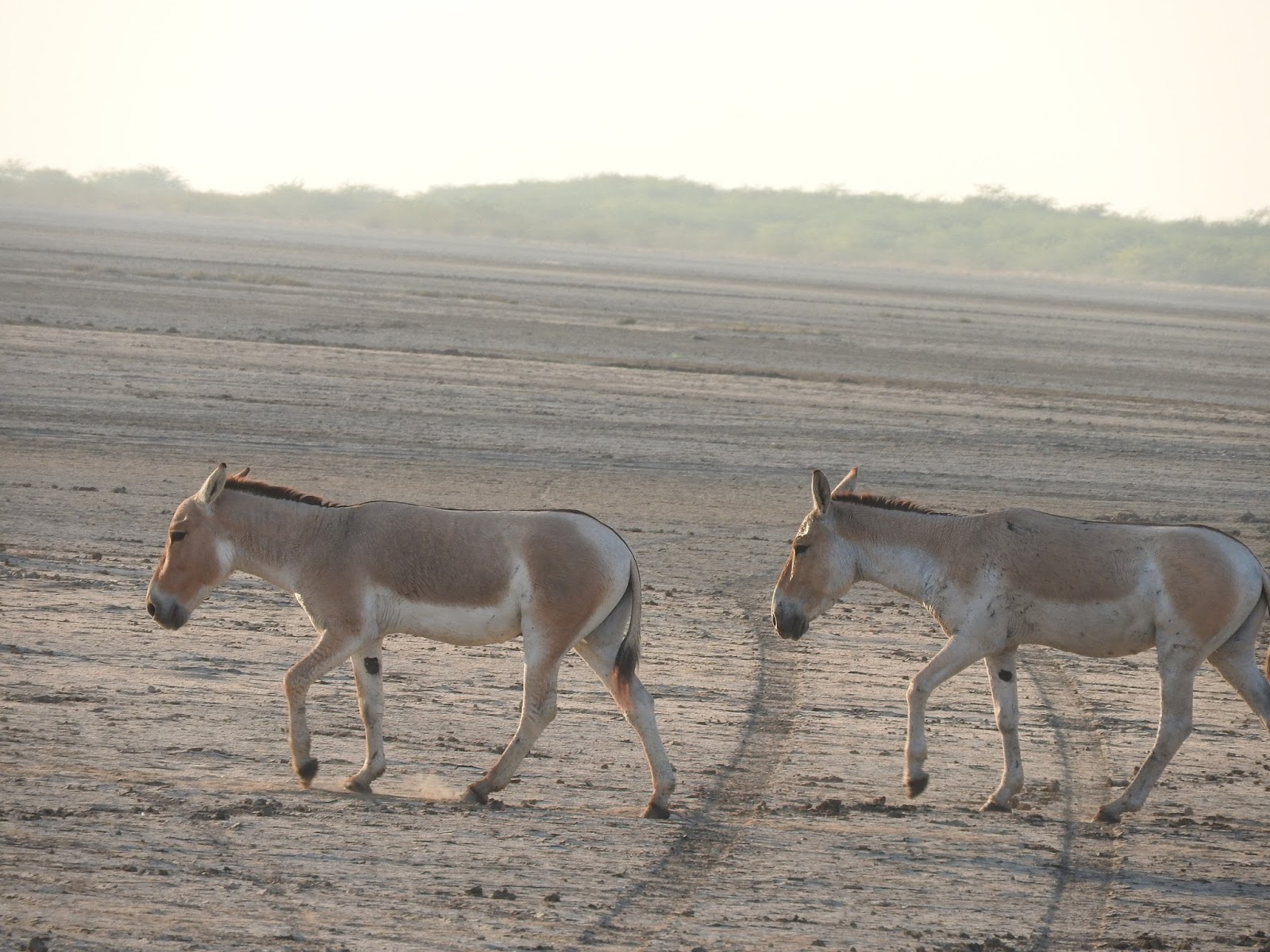
Asiatic Wild Ass at the Little Rann 


The Rann is quiet “yet through the silence, something throbs and gleams.”


The best way to reach the Little Rann of Kutch is to fly down to Ahmedabad 's SVP airport and then take a vehicle to your destination. Getting behind the wheels , Bee my travelling partner  took National Highway (NH) 947 and GJ SH 18 from Ahmadabad to Zainabad, a distance of 2hours 20minutes to reach Zainabad Camp run by Desert Coursers. You may book a chauffer -driven taxi  or go for myles-self-driven cars. The Little Rann of Kutch is at the periphery of the great salty-swamp and marks the beginning of the greater Rann. A brackish marshland with a bleak landscape it offers a bio-diversity which is unique to this world . The dry cracked earth and the salt desert makes this region distinctive and inimatable. 

A Kooba..... to spend the night


The resort run by Desert Coursers was started by the descendants of Nawab Zain khan and it is still managed by Dhanraj Mallick ,the son of the present Nawab. A very colourful person, who has seen the world, Mr Mallick can fill you up on all the things that you might want to know. The family is originally from Multan and came to Gujarat before the Mughals. The campus is dotted with “Koobas”, the eco-friendly cottages that gives the area a rural touch. Each Kooba has a bed-room, a dressing area provided with modern amenities and an attached bath-room, a shower and air-conditioning. The food is garden fresh, served hot, offering the local cuisine. In the evening the warm camp-fire and the starry sky above completes your holiday.

a tribal girl in a colourful applique skirt


Tucked into a corner of the country (India), the Little Rann inter-mingles diverse cultures and colours that have beckoned travellers for centuries. There are a number of nomadic and settled tribes in this part of India like the Rabaris, Kolis, Bajanias, Siddis (originally from Abyssinia) whose ethnic ways has added interesting hue to the otherwise austere yet beautiful terrain. You may be tempted to buy their ostentatious jewellery and colourful scarves. The Halari tribe, in particular is known for their appliqué work.

Nilgais


Flamingos


The wildlife tours on camels and jeeps will take you through one of the largest sanctuaries in India measuring 4950sq, km. The prize-winning animal is the Asiatic Wild Ass which is found nowhere else in the world. Chestnut brown in colour with white under-parts it is graceful and as strong as the horse. You may be lucky to see herds of them. The Nilgai, desert fox and a host of birds can be spotted. If you are lucky you will spot the chinkara gazelle (we didn’t). The water bodies around the Rann provide breeding ground and launch pads for migratory birds. Flamingos arrive in hundreds and are a sight to behold. Larks, land grouse, the common stork, nightjars and eagles are other birds that we spotted.

Sunset at Little Rann


The sunset and sunrise on the Rann is a photographer’s delight. With the wind on your face, the cracked earth below you and salt-pans in the distant horizon, there is a romance in the air which is inescapable and cloying. Day trips to the Sun Temple in Modhera and sari –shopping to Patan are to be included.
 A visit to the salt pans where salt is crystallized, gathered and despatched is a learning experience. The challenges and vicissitudes that the workers face make you realise how fortunate you are. The designated tribes  have been doing this work for generations. Their houses are sparse and clean .The people are  strong and optimistic.

In front of a salt mound


Tips: Take the afternoon trip to see the animals. Early morning safaris are to spot the birds. Cover yourself up because the wind can get strong at sun-set. Remember it’s an open land. Have shades and a hat with fasterners or the wind will sweep it away.  The water bottle is essential and of course a good pair of walking shoes .A powerful camera to capture the birds and the beasts for the wild-life buff.     


safari jeep, cracked earth and scattered salt  


"Short travel can be just as impactful and meaningful as long term travel"


Saturday, 10 December 2016

GRANADA-----Spain


.
GRANADA-----SPAIN
View of Granada

“How lazily the sun goes down in Granada, it hides beneath the water, it conceals in the Alhambra.”(Ernest Hemingway.)

GRANADA ,Spain.

“The Last sigh of the Moors” by Lauryn Christopher, touched my not-too-strong heart with an intense poignancy that made me want to visit Granada, in the province of Andalusia. It was the last bastion of the Moorish kings .The Moors ruled southern Spain for 700years before Boabdil, the last king, handed over the key of Granada to King Ferdinand and Queen Isabella thus completing the Christian” Reconquista” of the Iberian Peninsula.
 It was the first time I had heard about the magnificent Alhambra which led me to read further about that era. “Tales of Alhambra” by Irving Washington, for instance, is a brilliant exposition of that period. While I garnered information ,my travelling companion ,Bee, worked on the challenging logistics of reaching distant Granada from  North-east India in the most comfortable and affordable manner.
Many essentials have to be factorized before making a trip. The weather for instance would determine the clothes you pack into your 24”suitcase without it gaping at the seams when it rolls out on the arrival assembly line.  Granada was a challenge. Although, sunny Spain is warm, Granada situated at the foot of the Sierra Nevada Mountains, which are almost always snow-clad, is cold or cool in March, necessitating a light jacket, a cap and sturdy shoes. Good walking shoes are a must. Check the weather chart to determine whether you need an umbrella.


pictures of Olive groves taken from the train 
                         

How did we reach Granada?

So we set off to “discover the treasure of the Moors “and absorb the Andalusian sunshine.
In Madrid, we boarded the Tourist compartment of the train operated by RENFE, Spain’s largest state-owned rail network. The cap on luggage was 20kgs each, making it comfortable for all passengers. Helpful signage took us to the right platform and the right coach.

The journey takes you through a varied landscape of altitude, slopes and plains. At times you feel the train chugging upwards and at other times it’s rattling down at a fairy’s speed. The autonomous province of Andalusia, where Granada is located, is distinctive in its character and identity, influenced historically by the Romans, Carthaginians, Byzantine, the Christian rulers and particularly by the Moors.
 The plains would be almost stark had it not been for the beautiful olive trees covering acres and acres of land. Memories of Van Gogh’s series of “The Olive Trees,” flashed through my mind. Then you see the quiet mountains looming in the distance. In fact it is the most mountainous region of Spain protecting a culture which is unique by itself. Many features which we consider to be Spanish, for example the Flamenco dance, are distinctively Andalusian .At times the music has a Middle-eastern ring.
As the train rumbled into the station, the unfamiliar engulfed us as we entered unknown land without a guide or agent depending solely on the internet and the GPS.


Court of the Lions, Alhambra 
   Where did we stay?

It took us a long time to decide where to stay. We had initially decided on one of the hotels in the Albaycin area, being a World Heritage site with a distinctive Moorish influence. The smell of hookah and incense gives it an un-Spanish ambience. But after reading reviews in various travel forums about muggings and brigands, which we later realised were absolutely untrue, decided on a hotel with a very exhilarating name “Granada Five Senses Rooms and Suites.”Truly our senses were pampered by the excellent staff, cleanliness, cuisine and location on the Central Gran via Avenue. 

The Albaycin area and Granada in general are not remotely crime-infested as Bangkok, New Delhi or London. Necessary precautions should always be taken where-ever you travel. Avoid the narrow thoroughfares especially in the afternoon (when the whole of Spain is on “Siesta”) or after dark.  Besides, the little alleys are a little confusing and there is every chance you may lose your way. Unlike Venice, the signage is sparse. The roads in Albaycin are narrow ,cobbled, often crowded with tourists: there is a gradient which sometimes makes it difficult for the elderly or little children or even taxis to manoeuvre. So if you have a large suitcase to haul with children in tow, take a hotel in the lower reaches. But it is a must-see area.....a little off-beat, bohemian and unconventional reminding us of the “hippy decade “of our youth. Cafes and restaurants are open till late in most parts of Granada. In fact we could hear laughter and merry chatter till 2am and this is very common in Spain. A kid being awake till late and entering bars is not unusual. 

Granada is inter-laced with romantic tales and fantasy. Many old citizens still believe there is immense wealth hidden in some of the abandoned forts left by the Moors. Episodes of knights in armour and beautiful princess abound.  Not knowing the language was to our disadvantage, missing out on many stories from the friendly folk.


Alleys in the Albaycin area
                           
What did we see?

The citadel and palace of Alhambra is the biggest attraction in the city. Belonging to the Nashrid period, its spectacular architecture, waterways and gardens have attracted visitors from all over the world. Book your tickets on-line and reach early to avoid the queues. Remember daily footfalls are limited and afternoons can get hot.  Generalife is the pleasure palace and immaculate garden where time can be well-spent.
We walked down from Alhambra to Plaza Neuva. You just need a good pair of walking shoes to do this route. The square is of medium size. On a sunny day the area fills with students, tourists and entertainers. There are a number of cafes and souvenir shops, often tourist –traps, but there’s no harm picking up one or two curios to add to your memorabilia. You may see antique stuff like an old copper bowl which may have been common in the days of Don Quixote!!!
There are countless museums, statutes and museums to explore. You can’t leave without visiting the Cathedral .  The “hamam”is a must-see. So are the flamenco dances at the caves in the Sacromento area. Tickets to these shows include transportation, dinner/drinks (optional) and a tour of the neighbourhood which took us to Mirador de San Nicolas from where we got a spectacular view of Alhambra at night.
The Carrero del Darro is just a street along the river Darro and it is difficult to rate a street . But having read reviews we decided to give it “dekho”which was worth the walk. Located on the left bank of the river ,it is narrow with ancient bridges , old re-notated bath-houses at the end of which there is a square abounding with activities.
A trek into the country-side or into the Sierra Nevada mountains which form the distant boundary of Granada can be included if you have time in hand


Flamenco dancer
  What did we eat?

The cuisine is as varied as Spain’s provinces, each region having its own cuisine. “Paella” the national dish, actually belongs to the area of Valencia.  Granada oranges and other citrus fruits are aplenty. Gazpacho (a soup) La Tortilla de Sacromento (stuffed omelette), Chicharron (pork dish), Pionomo (sweet  pastry similar to Swiss Roll) and a variety of tapas featuring olives, ham, and cheese satiated our hunger. Mention must be made of “El Olivio” restaurant, 30 minutes from downtown where for 39dollars + you get a treat of a set menu of 7 courses. The chef takes time off to explain each dish and guides you through different wines and olive oils. The place is of a different calibre and unique in style and decor.


Paella
Paella


Granada is a fusion of the east and the west. The place exudes a kind of romance and encourages one to mingle with one and all.
Let me narrate an incident to illustrate the  friendly and helpful character of its citizens.  It so happened that I banged my head against a lamp in the hotel which left a painful lump. Next day I went to the nearest Pharmacy looking for an ointment armed with the Google translator not having faith in my scanty, accented Spanish.  I realised that the person behind the counter ,with a brimming smile,  understood me all right, but could not communicate what he wanted to say since he did not know how to use the translator. At that moment a young gentleman  who turned out to be a journalist visiting his parents in Granada but based in Hongkong, entered into the scene. He spoke fluent Spanish, English and French and had visited Mumbai and ( Oh my God!!) even knew where my home-town was, (Golaghat) thanks to the famous Kaziranga national Park. He acted as the mediator and got me the requisite medicines.  Like a true knight of yore, he walked me down to the hotel after exchanging e-mail adds.

To end......"Once you have traveled , the voyage never ends......."

The Alhambra from Mirador de San Nicholas